Competitive programmer · Singapore

Zheyuan
Yu

  • Codeforces Grandmaster (2488)
  • USACO Platinum, perfect scorer
  • Code Jam & Hacker Cup Top 50
  • USAMO Qualifier

Competitive programming, and more recently quantitative research.

Quant research intern at MS Capital · Cambridge CS this autumn · open to quant internships

01About

About

I'm starting Computer Science at Cambridge this year. Most of my time so far has gone to competitive programming and a graph-neural-network research project; more recently to computer vision at Huawei and quantitative research at MS Capital, where I read the literature and test the strategies myself.

Education

  • University of Cambridge

    BA Computer Science, St John's College

    2026 – 2029 · United Kingdom

  • NUS High School of Math and Science

    Honors in Mathematics; Majors in CS, Physics, Chemistry

    2020 – 2023 · Singapore

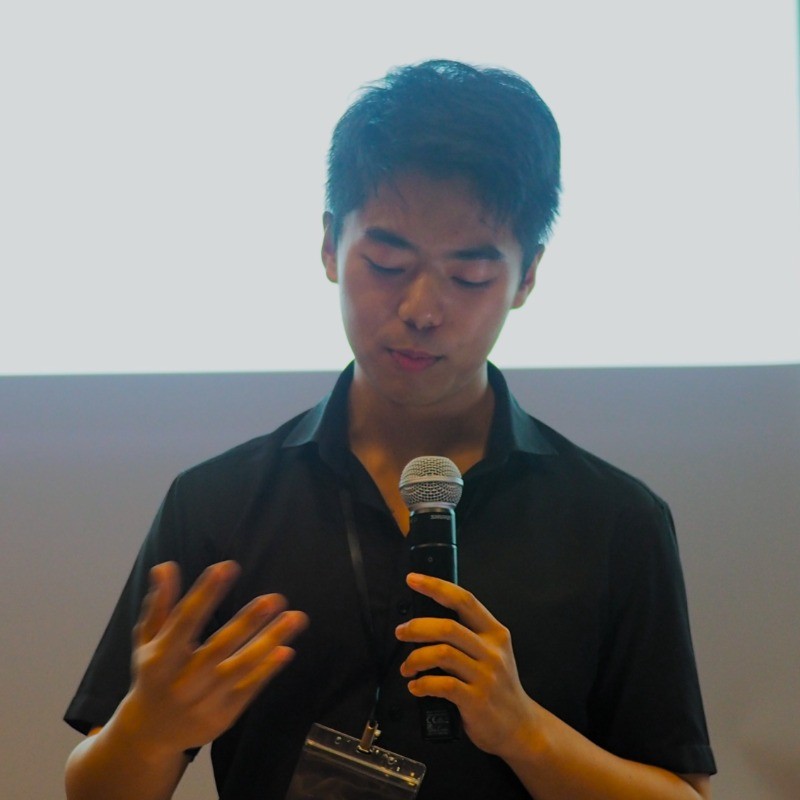
Portrait of Zheyuan Yu
02Projects

A systematic-equity research project I built on my own.

quantnews

2026

News-driven systematic equity signals.

A closed-loop system for systematic equity trading. It turns unstructured news and filings into ranked, risk-gated trade ideas, then tracks which ideas were taken and how they resolved, closing the loop from signal to review.

  • Ingests RSS, SEC EDGAR 8-K items and Form 4 insider transactions, earnings-call transcripts, and analyst revisions into one signal store.
  • Scores each event with Claude, then calibrates raw conviction to empirical hit rates with Bayesian shrinkage before ranking.
  • Gates sizing on market regime (SPY/QQQ breadth) and risk-off rules: earnings windows and clustered insider selling stand a position down.
  • Validates every signal with event-study backtests and walk-forward calibration on a broad S&P 100 sample, across multiple market regimes.
  • Python
  • SQLite
  • Anthropic API
  • SEC EDGAR
  • yfinance
  • GitHub Actions
Read the project notes →

Code is private; it’s a personal research system.

Pipeline

  1. RSS + SEC EDGAR

  2. Claude scoring

  3. regime-gated, risk-checked ideas

  4. tracked theses

  5. review

03Work

Four roles, from teaching contest algorithms to quant research.

  1. MS Capital

    Apr 2026 – Present · Singapore

    Quantitative Research Intern

    • Researched factor momentum: pulled strategies from the academic literature, implemented them, and backtested out of sample to see which held up.
    • Engineered features from raw market data and evaluated signals on held-out periods, controlling for lookahead and overfitting.
    • Built the agent pipelines that turned the research loop from manual to repeatable, raw data through to backtest.
    • Factor momentum
    • Backtesting
    • Feature engineering
    • AI agents
  2. Huawei Singapore

    Jan 2026 – Mar 2026 · Singapore

    Computer Vision Algorithm Engineer Intern

    • Built models to pull regions of interest out of images under tight compression limits.
    • Looked into the trade-off between latent-space regularization and reconstruction quality in generative models.
    • Put together a hybrid VAE and reinforcement-learning setup for adaptive image compression.
    • VAE
    • Reinforcement learning
    • Image compression
    • PyTorch
  3. Temasek International

    Oct 2023 – Dec 2023 · Singapore

    Data Analytics Intern

    • Analyzed financial datasets with SQL and Tableau to surface trends for the investment team.
    • Built dashboards adopted by senior analysts for portfolio reporting.
    • Presented findings to stakeholders to inform investment decisions.
    • SQL
    • Tableau
    • Dashboards
    • Financial analysis
  4. NUS December Course

    Nov 2022 – Dec 2022 · Singapore

    Lecturer

    • Wrote the curriculum and original contest problems for 100+ of the country's top students.
    • Ran workshops on algorithms, data structures, and problem-solving with the other lecturers.
    • Teaching
    • Curriculum
    • Competitive programming
04Awards

The competitive record.

Programming and olympiad maths. The headline results link straight to the source.

Competitive Programming

Mathematics

  • USA Mathematical Olympiad

    Qualifier, 2021

  • USA Junior Mathematical Olympiad

    Qualifier, 2020

  • Singapore Mathematical Olympiad, Open

    Top 10, 2020

  • Singapore Mathematical Olympiad

    Gold, 2020–2022

Scholarships

  • Tay Eng Soon Scholarship

    NUS High School

  • Edusave Scholarship for Independent Schools

05Research

2022 · Unpublished research

Optimizing Longest Simple Path with Machine Learning

Karimi Zayan, Zheyuan Yu, Tia Shi Wei. Mentored by Rishabh Anand and Ng Chee Loong, NUS High School.

The longest simple path problem is a classic NP-complete problem, with applications from circuit-board design to robotics. We approximate it on general undirected, unweighted graphs by training a GraphSAGE graph neural network to score each edge on its likelihood of lying on the longest path, then running beam search over those scores to construct the path.

  • Trained a GraphSAGE GNN to classify edges by their probability of belonging to the longest simple path, using adjacency-matrix eigenvectors as node features and a weighted loss to correct dataset bias.
  • Drove beam search with the product of predicted edge weights, keeping the top candidates at each extension step.
  • Generalized beyond the training distribution: trained on 20-vertex graphs, evaluated on graphs up to 200 vertices.
View source on GitHub

Results

Our GNN0.977
Genetic algorithm, 20100.971

performance ratio, higher is better. +0.6 points over the 2010 baseline. Axis zoomed to 0.950.98.

99.6%edge-classification accuracy on small graphs

Trained on 20-vertex graphs, the model still finds near-optimal paths on graphs up to 200 vertices, generalizing well beyond its training size, and edges a 2010 genetic-algorithm baseline.